
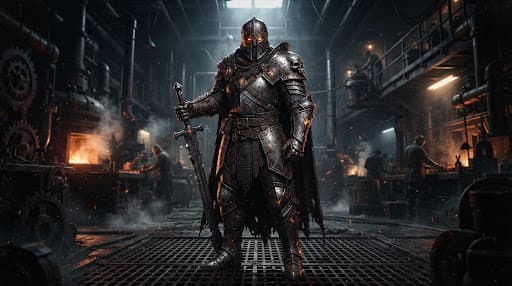
Ruadh Stonecrusher
- Role
- Hammer frontliner and support
- Difficulty
- Not officially rated
- Unlock
- Defeat the Banshee
Ruadh combines shield and armor pressure with displacement and healing in his official reveal, making him the clearest current fit for players who want a heavy front-line support style.
Quick summary
- Current roster: Ruadh is one of the three playable Early Access Heroes.
- Unlock: defeat Iseult, the Banshee, according to version 0.8.57278.
- Weapon: a massive hammer in the official Ruadh reveal.
- Official role language: shield breaking, armor shattering, knockback and ally healing.
- Community reports favor his reach and area pressure but repeatedly flag slow attacks, movement and solo-boss recovery.
- The build approaches below are candidates for testing, not current-build tier-list claims.
Unlock Ruadh
- 1
Continue beyond Gilles
Complete Act 1 and progress through the next generated objective sequence toward Iseult, the Banshee. - 2
Use the current Banshee rule
In version 0.11, damage affects the stun bar more, parries affect it less and the bar decays more slowly. - 3
Defeat the Banshee
Paper Cult's official 0.8 note ties Ruadh's unlock directly to this victory. - 4
Verify the roster state
Check Hero selection after the encounter transition. If Ruadh remains locked, record the version and Steam branch before reporting a bug.
Officially described combat role
| Function | Reveal description | Practical interpretation |
|---|---|---|
| Shield pressure | Smashes through shields | A natural candidate for Block-bar pressure |
| Armor pressure | Shatters armor | Use live icons and enemy state to confirm the applicable action |
| Control | Knocks enemies away | Creates space, but no universal knockback distance is claimed |
| Support | Keeps allies alive with powerful healing | Supports co-op and army survival without proving an exact heal value |
Two evidence-labeled Ruadh build approaches
| Approach | Priorities to test | Best-fit scenario | Failure conditions | Evidence status |
|---|---|---|---|---|
| Crowd-control / co-op support | Block and armor pressure, area control, healing access, then movement or dodge recovery; Vortex or Linked effects are community candidates, not prescribed names | Dense encounters where allies can punish displaced or softened groups | A boss or elite ignores the crowd-control value; long attack commitment leaves no safe exit; healing is treated as unlimited | Official role + community build suggestions; not site-tested |
| Patient solo-boss pressure | Use hammer reach, short confirmed combo windows, movement or dodge recovery and a saved healing option | Single-target fights where spacing and repeated safe punishes matter more than wave clear | Greedy full strings, sitting at an unsafe middle distance, assuming every attack can be block-cancelled or spending the heal too early | Community observations with disputed mechanics removed; not site-tested |
What the current community reports broadly agree on
- Ruadh's hammer reaches farther than its animation speed may initially imply;
- area pressure and shield breaking feel more comfortable in groups than in long solo-boss exchanges;
- movement speed or dodge recovery can reduce the cost of his slow commitment;
- patience and short punish windows matter more than forcing a full combo;
- retaining a healing option can be more valuable than spending it on routine damage.
These points are observations, not measured balance facts. Use the Emblem Catalog to inspect the small verified reference set and the build-planning framework to turn the effects offered in your run into a trigger-and-payoff plan.
Disputed or still unverified
The community thread does not establish one best Clan, one best weapon variant, exact dodge recovery thresholds, a universal combo string or reliable block-cancelling for every attack. Trials-specific performance also remains unverified. Those claims stay out of the recommendation table until a current version, loadout and repeatable test route can be recorded.
Sources
- Paper Cult's version 0.8.57278 announcement
- Official Ruadh reveal hosted by IGN
- Paper Cult developer reply naming the current Heroes
- August 17 Ruadh build discussion on r/TearsofMetal